
Blog
5V vs 12V vs 24V Pixels: Why Most Modern Displays Use 12V or 24V

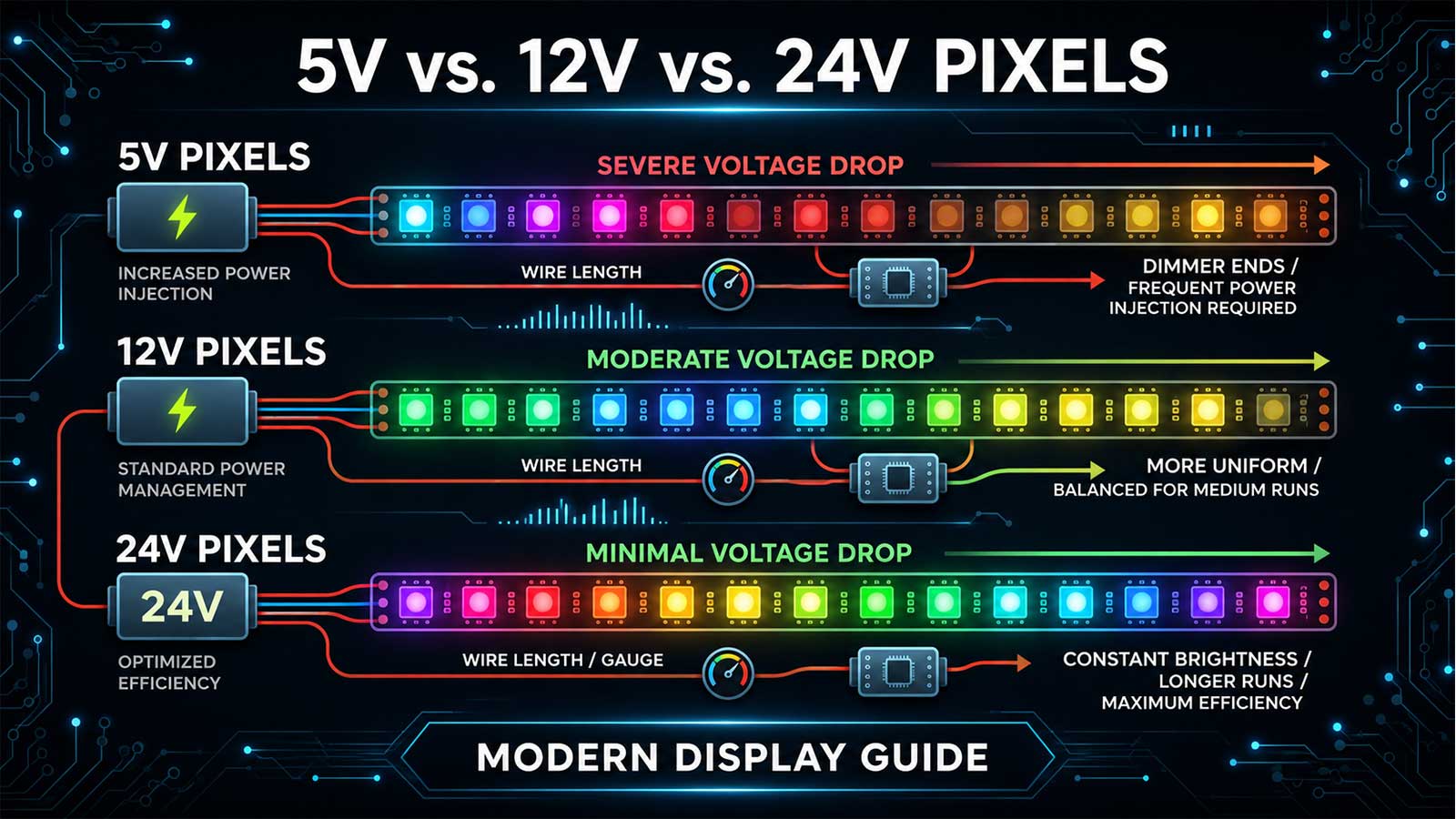
Picking a pixel voltage is one of the first real decisions in a build, and it’s the one that quietly sets how much wiring work you’re signing up for later.
Most outdoor displays today run 12V. Some larger commercial jobs run 24V. 5V still has a place, and we stock it, but it’s a specific tool rather than a default.
Here’s how to pick, and what you give up either way.
The quick answer
Go 12V for most residential displays. Rooflines, windows, props, arches, mega trees, general Christmas and Halloween shows. It’s the practical middle and it’s what most of our customers buy.
Consider 24V for long runs, building outlines, architectural lighting, and commercial installs where you want fewer injection points. Just confirm every part in the chain is rated for it first.
Use 5V when the run is short and the supply is close. Dense matrices, small props, indoor builds, anything where you’re measuring in feet instead of yards.
If you want a starting point, our 12V WS2811 resistor pixels cover most builds, and the 12V pebble seed pixels handle tighter spacing.
Why voltage changes the build
Wire eats voltage. The longer the run and the thinner the wire, the more you lose by the time power reaches the far end. That’s voltage drop, and it’s why pixels at the end of a long string go dim, shift color, or flicker.
What matters isn’t how much you lose. It’s how much you have left.
Lose two volts on a 5V run and you’re down near 3V, which is below what the pixel needs to hold color. Lose the same two volts on a 12V run and you still have 10V, and the pixel doesn’t care. Same loss, different outcome.
That single fact drives almost every voltage decision in this hobby.
Higher voltage also means less current for the same wattage, so the same wire carries power further before it becomes a problem.
If you want the electrical side in more depth, including how the driver chip handles voltage and what the datasheet actually specifies, our WS2811 vs WS2812 guide works through it. New to all of this? Start with the complete pixel lights guide.
5V pixels
5V is the right call when the pixels and the power supply live close together.
Dense matrices, small props, indoor builds, prototype rigs, anything on a bench. In those setups the wire runs are short enough that drop never becomes an issue, and 5V keeps the parts count low.
5V is also where most strip lives. If you’ve been reading about WS2812B, that’s a 5V chip, and it’s the reason so much strip ships at 5V by default.
We stock 5V WS2811 bullet pixels and 5V resistor bullets for exactly these builds, along with 5V power supplies to match.
Where 5V gets frustrating is the long outdoor run. You’ll be injecting power more often, watching wire gauge more carefully, and chasing color shift that turns out to be a wiring problem. Plenty of people do it. It’s just more work per foot than 12V.
12V pixels
12V is what most outdoor displays run, and there’s a reason it became the default.
You get real distance before drop matters, wide support across controllers and power supplies, and a huge parts catalog behind it. Rooflines, arches, mega trees, singing faces, coro props, permanent lighting. All of it works at 12V.
For most builders this is the practical sweet spot: better distance than 5V, without the compatibility checking that 24V asks for.
Our 12V WS2811 100ct strings are the standard workhorse. If you’re after strip instead of nodes, the WS2815 12V strip gives you 12V distance in a strip format. The full range sits in the pixels category.
24V pixels
24V shows up on larger and commercial jobs. Lower current for the same load means longer runs and fewer injection points, which matters when you’re outlining a building instead of a house.
The catch is compatibility. Your pixels, controller, power supply, fuses, wire, and accessories all have to be rated for 24V. Mixing a 24V supply into a 12V chain will cost you pixels.
Being straight with you: we don’t stock 24V addressable pixels. We carry a 24V power supply and a 24V COB RGB strip, but the COB is analog RGB and indoor rated, so it isn’t a pixel product and it won’t run from a pixel controller.
If you’re planning a 24V job, spec the whole chain together before you buy anything, and talk it through with someone first. Our one-on-one help exists for that kind of planning call.
What this means for power injection
Power injection means feeding fresh power partway down a run so the far end doesn’t starve.
Voltage changes how often you’ll do it. 5V needs it most. 12V needs it less. 24V needs it least. That’s the whole relationship, and it’s the main reason voltage is worth thinking about before you order.
What voltage doesn’t do is remove the planning. Every large display still needs correct wire gauge, fusing, and enough supply capacity, whatever voltage you picked. A 24V run that’s badly wired will still fail.
For specific injection distances and how to work them out for your own run, see the WS2811 vs WS2812 guide. When you’re ready to build it, the injection tees and F-amps are here.
Matching your controller and power supply
Voltage isn’t just a pixel choice. It’s a system choice.
Your controller has to feed the right voltage per port, and your power supply has to match. A 12V build usually means 12V pixels, a 12V 600W supply, correct fusing, and wire sized for the run.
The YPS VIVID 8 handles serious displays, and the Ready2Run controllers come wired and configured if you’d rather skip the build. The rest of the range is in pixel controllers, with matching power supplies here.
Side by side
| Voltage | Best for | Main advantage | What it costs you |
|---|---|---|---|
| 5V | Small props, dense matrices, indoor and bench builds | Simple on short runs, fewest parts | Frequent power injection, short usable runs |
| 12V | Most residential displays, rooflines, props, mega trees | Best all-around balance, widest parts support | Still needs injection planning on long runs |
| 24V | Commercial installs, building outlines, long runs | Longest runs, fewest injection points | Every part in the chain must be 24V rated, and pixel options are limited |
Which one should you buy
If you’re building a yard display, buy 12V. It’s the answer for the large majority of shows, the parts are everywhere, and it gives you room to grow without redoing your wiring.
If you’re outlining a commercial building or running unusually long distances, price out a full 24V chain and see whether the reduced injection work pays for the extra spec checking and the narrower parts choice.
If your run is short and the supply is right there, 5V is fine and we’ll sell it to you.
Still not sure? Tell us what you’re building and we’ll tell you what to buy. That’s the one-on-one help part.
Want the wider picture on pixel types and how they fit together, see our complete guide to pixel lights.
Your Pixel Store. Helping your show come to life.
FAQ
Are 24V pixels better than 12V pixels?
Not by default. 24V wins on long runs, large jobs, and commercial installs where fewer injection points saves real labor. For a standard yard display, 12V is still the better buy and much easier to source parts for.
Are 24V pixels brighter than 12V pixels?
No. Brightness comes from the LED itself, the product design, and how much power you’re actually delivering. The 24V advantage is reduced voltage drop, not output.
Do 24V pixels need power injection?
Yes, just less often. Fewer injection points than 12V or 5V, but a long run still needs a plan, correct wire gauge, and proper fusing.
Can I mix 12V and 24V pixels in one display?
Yes, as long as each voltage gets its own correct power supply, wiring, and controller port settings. Never feed 24V into 12V pixels. You’ll lose them.
Does the same 5V, 12V, and 24V choice apply to LED strip and tape?
Yes, and it matters more with strip. Strip packs LEDs far tighter than nodes do, so it pulls more current per foot and hits the voltage-drop wall sooner. A 5V strip run needs injection much more often than 12V, and 24V tape stretches furthest of the three. For addressable outdoor strip we’d point you at 12V WS2815, which gives you 12V distance with a backup data line.
What voltage should a beginner start with?
12V. It’s easier to work with than 5V over any real distance, and every controller, power supply, and accessory in the hobby supports it.
Is WS2811 5V or 12V?
Both exist. WS2811 is the driver chip, not the voltage, and it’s sold in 5V, 12V, and 24V builds. The WS2811 vs WS2812 guide explains why the chip works across all three.
Does 12V use less power than 5V?
No. A 12V pixel drops the extra voltage down to what the LEDs need right at the pixel, and that difference leaves as heat. What 12V buys you is less voltage drop across long wire, which is a wiring advantage rather than an efficiency one.
Does it matter which voltage I pick if I’m running WLED?
Not to the software. WLED, xLights, and FPP all drive the data line, and data doesn’t care about your pixel voltage. What has to match is the power side: the right supply, the right per-port voltage on the controller, and injection planned for the voltage you chose.
One thought on “5V vs 12V vs 24V Pixels: Why Most Modern Displays Use 12V or 24V”